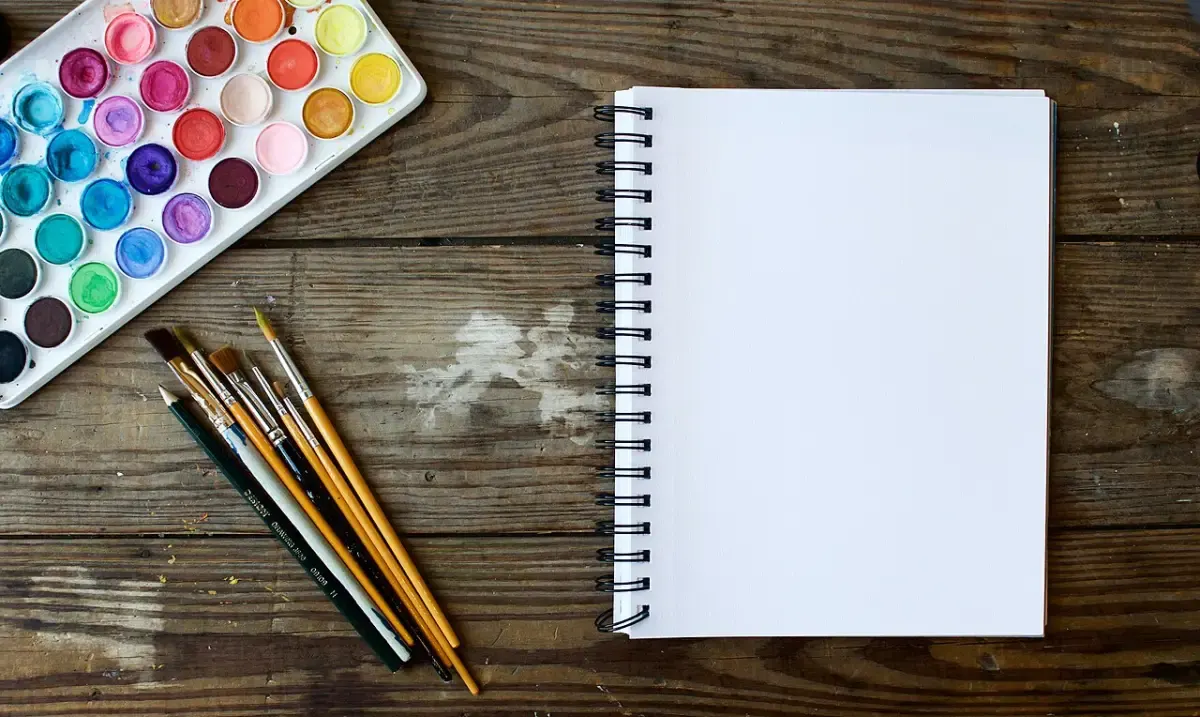
Look at what is on this table: a tray of watercolour pans, a small group of brushes, and a spiral-bound sketchbook with a clean white page waiting. That is all you need to start. People tend to assume that a serious practice requires a long shopping list, and it rarely does.
What matters is that the kit is together and within reach. A sketchbook that lives in a drawer and a paintbox that lives on a shelf are two separate chores. On the same table, they become one easy habit.
Why a spiral binding
The wire spiral lets the book fold fully back on itself, so you can work on one page without the cover or the neighbouring sheet getting in the way. It also lies flat on a table, which helps when you are laying a wash and need the surface level.
The cost is that the spiral can press into your wrist if you work across the gutter, and a double-page spread will always have a gap down the middle. For quick studies and daily practice, we think the trade is worth it.
The handful of brushes
You do not need ten. A small collection covers nearly everything.
- A medium round for most of your marks
- A small round for detail and signing off a page
- A larger round or flat for washes and backgrounds
- A pencil or fine liner for drawing before you paint
The brushes in the photograph look about right: a few with natural-coloured hair, a few with a darker tuft, long handles resting together. Keep the tips from touching anything while they are stored, and they will keep their shape.
How to work in a book like this
Start with a pencil sketch, light enough that it will not show through the colour. Wet the pans a minute before you need them so the paint softens, then mix on a tray rather than on the page. Test every new mix on a scrap corner before committing it to the sketch.
The first wash is a question. Wait for the answer before you ask the second.
Let each layer dry before adding the next. If the paper buckles a little, that is normal in a sketchbook, and a heavier paper will cope better with water. We will cover weights in another note.
Closing the book
When you finish, leave the pages open for a few minutes so the paint can dry, then close the cover. Close it too early and wet colour will print onto the facing page. Wipe the pans, rinse the brushes, and put the lot back where you found it.
That is the whole practice. A table, a tray of colour, a few brushes and a book. If you would like to see which of our sketchbooks opens flattest, the workshop team can tell you.