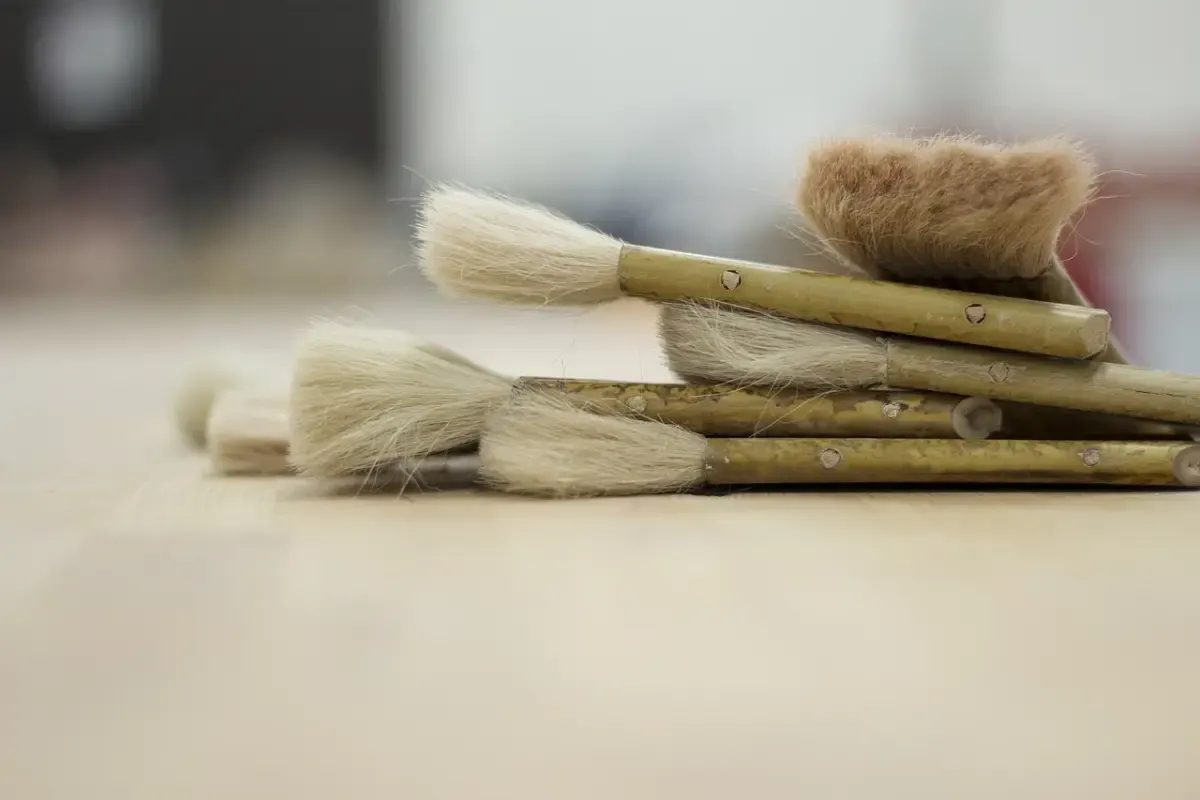
The brushes in this photograph have clearly done some work. The hair is soft and slightly uneven, the bamboo handles are stained, and a few of them have the shaggy look of brushes that have been rinsed a thousand times. We would not swap them for new ones. A brush like this has learned how to hold water.
They are wide, flat-set brushes with natural hair, the kind often called hake brushes. They are not for detail. They are for wetting paper, laying down large washes and softening edges, and they do it with a gentleness that a stiff synthetic brush struggles to match.
Why natural hair holds so much
Natural hair has tiny scales along each strand, and those scales trap water between the fibres. Load one of these brushes and it will keep releasing liquid steadily as you pull it across the page, instead of dumping it all at once. That even release is what makes a smooth wash possible.
The trade-off is that the hair has little spring. It will not snap back to a point, and it will not push thick paint around. Use it for water and thin colour, and it behaves beautifully.
Three jobs for a wide soft brush
- Wetting the whole sheet evenly before you start a sky or a background
- Laying a flat wash in one or two confident passes
- Lifting colour gently from a damp area to soften a hard edge
None of these asks for skill so much as patience. Load the brush, tilt the board slightly, and move at an even speed. If you stop in the middle of a stroke, you will see where.
Looking after brushes like these
A brush that has been rinsed carefully and dried lying flat will outlive three that were left standing in water.
That sentence is the whole of our care advice, and it is worth unpacking. Standing a brush in a jar of water bends the hair permanently and loosens the glue where hair meets handle. Lay it on a clean cloth after rinsing, shape the hair with your fingers, and let it dry in the open air.
Bamboo handles can crack if they stay wet, so dry the wood as well as the hair. Wipe the handle with a cloth and keep the brushes off a damp surface.
When to replace one
A well-used brush is not the same as a worn-out one. Replace it when the hair sheds heavily into your wash, when the ferrule wobbles on the handle, or when the shape will no longer settle after rinsing. Otherwise, keep it. The slightly ragged edge you see in the photograph is not a flaw, and it often gives a more natural, softer line than a brand new brush would.
If you are starting out, one wide natural-hair brush is a good second purchase after a round. Ask us and we will tell you which of our brushes suits the size of paper you work on.